Contact centers are under more pressure than ever. Customers expect instant answers, personalized experiences, and seamless service across phone, email, chat, and social channels. At the same time, leaders are asked to reduce costs and improve operational efficiency.
How AI transforms call center operations is clear with contact center AI solutions. With tools like an AI voice bot, combined with automation, intelligent routing, analytics, and real-time guidance, AI turns your contact center into a strategic engine for customer satisfaction, loyalty, and revenue growth.
As businesses navigate an era of rapid digital transformation, advanced technologies are reshaping how organizations operate and engage with customers. Intelligent cloud platforms allow contact centers to scale seamlessly while leveraging AI-driven analytics to anticipate customer needs and optimize resource allocation. Meanwhile, digital computing innovations provide the backbone for handling massive volumes of interactions, ensuring that both human agents and AI tools like voice bots perform efficiently.
On the marketing front, AI-powered customer engagement tools enable personalized outreach, predictive recommendations, and automated campaign management, helping businesses connect with the right audience at the right time. Similarly, smart marketing analytics harness machine learning to uncover patterns in customer behavior, drive targeted strategies, and improve overall conversion rates.Financial operations are also being transformed by AI-enabled finance solutions, which streamline transactions, detect anomalies, and provide actionable insights for better decision-making. Together, these technologies create an ecosystem where AI doesn’t just support contact center operations—it actively enhances customer experience, boosts efficiency, and drives measurable business growth.
What Are Contact Center AI Solutions?
Contact center AI solutions are a set of technologies that use artificial intelligence and machine learning to improve how customer interactions are handled. They work alongside your agents and existing platforms to:
- Automate routine tasks and common inquiries
- Guide agents in real time with suggestions and next-best actions
- Analyze every interaction to surface insights and trends
- Personalize experiences based on customer history and context
These capabilities can be applied across all channels, including voice, chat, email, messaging apps, and social media, creating a consistent and intelligent customer experience wherever your customers choose to engage.
Top Contact Center AI Solutions
Choosing the right AI-driven contact center platform can make a huge difference in customer experience, operational efficiency, and overall business growth. Here are some of the leading solutions in the market:
- Bright Pattern –
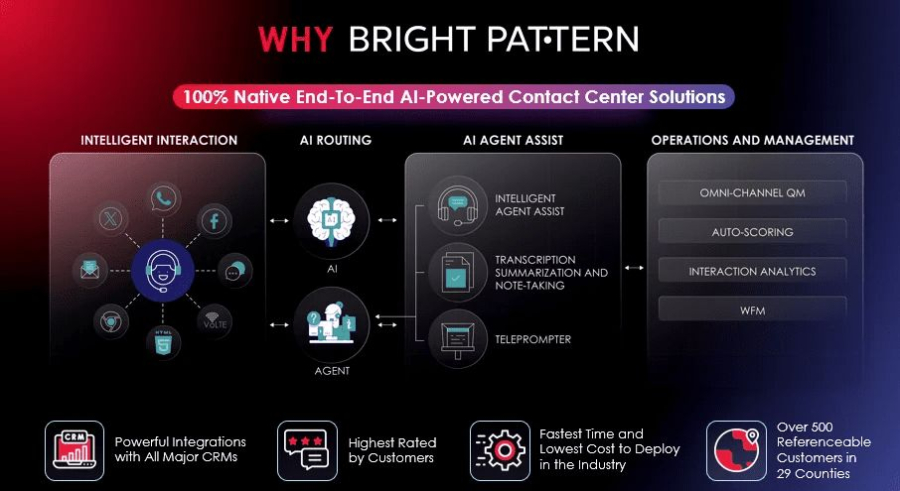
Bright Pattern offers a comprehensive AI-powered contact center platform that combines intelligent routing, AI voice bots, omnichannel support, and advanced analytics. Its real-time guidance tools help agents resolve customer issues faster, while automation and AI insights improve operational efficiency. Bright Pattern stands out for its ability to seamlessly unify interactions across chat, voice, email, SMS, and social media, ensuring a consistent and personalized customer experience.
The platform’s AI voice bots handle routine inquiries efficiently, freeing up agents to focus on complex tasks. Bright Pattern also provides robust reporting and analytics, giving managers actionable insights to optimize workflows, reduce wait times, and drive customer satisfaction. Its cloud-native architecture ensures scalability, reliability, and easy integration with CRM systems and other enterprise software. With a strong focus on user experience, Bright Pattern empowers businesses to deliver smarter, faster, and more meaningful interactions at every touchpoint, making it a top choice for organizations seeking to transform their contact center operations.
- Genesys Cloud – Provides AI-enhanced customer experience solutions with omnichannel routing and predictive engagement capabilities.
- Five9 – Offers intelligent cloud contact center software with AI-powered automation, analytics, and workforce optimization tools.
- NICE inContact – Features AI-driven customer journey analytics, automation, and smart routing to improve service efficiency.
- Twilio Flex – Customizable contact center platform with AI integrations for chatbots, voice bots, and workflow automation.
- Avaya OneCloud – Delivers AI-enabled customer interactions, analytics, and agent assist solutions across multiple channels.
- Cisco Webex Contact Center – Provides AI-powered routing, virtual agents, and real-time analytics for omnichannel support.
- Talkdesk – Uses AI and automation to enhance customer service, with smart workflows and predictive analytics.
- Zendesk – Offers AI-driven support tools, automated ticketing, and customer insights to improve engagement.
Why AI-Powered Contact Centers Win
Modern contact center AI solutions are not just about cost savings. They unlock a powerful combination of better customer experience, happier agents, and stronger business performance.
1. Faster, Always-On Customer Service
- 24/7 availability.AI-powered virtual agents and chatbots handle inquiries any time of day, without wait times.
- Instant answers.Automated responses resolve common questions in seconds, from order status to password resets.
- Smart escalation.When human help is needed, AI passes the context to an agent so customers never have to repeat themselves.
2. Higher Customer Satisfaction and Loyalty
- Personalized experiences.AI uses customer history, preferences, and behavior to tailor responses and offers.
- Consistent quality.AI-driven guidance helps every agent provide on-brand, compliant answers.
- Proactive support.Predictive models can flag at-risk customers and trigger timely outreach or retention offers.
3. Leaner Operations and Lower Cost per Contact
- Automation of repetitive volumes.Self-service deflects a large portion of routine contacts, reducing pressure on live agents.
- Reduced handle times.Real-time knowledge suggestions and summaries speed up each interaction.
- Smarter staffing.AI forecasting helps align staffing to demand, minimizing overtime and idle time.
4. Empowered, More Productive Agents
- Agent assist.On-screen prompts, suggested replies, and automated after-call summaries reduce cognitive load.
- Less repetitive work.Agents spend more time on complex, value-added interactions and less on routine tasks.
- Higher engagement.With better tools and fewer stressful bottlenecks, agents are more likely to stay motivated and engaged.
5. Data-Driven Insights at Scale
- Analytics on every conversation.Speech and text analytics turn calls and messages into searchable, actionable data.
- Quality assurance at scale.Instead of sampling a small subset of calls, AI can evaluate every interaction.
- Continuous improvement.Insights feed directly into training, script optimization, and product improvements.
Core Components of Modern Contact Center AI Solutions
Most contact center AI platforms combine multiple capabilities that work together. Here are the core building blocks to understand.
1. Conversational Virtual Agents and Chatbots
Virtual agents and chatbots use natural language understanding to converse with customers via voice or chat. They can:
- Answer common questions and FAQs
- Authenticate customers and gather details before handoff
- Complete simple transactions, such as updating account details or booking appointments
- Seamlessly transfer conversations to live agents with full context
Generative AI can further enhance these bots with more natural, human-like responses while still following your policies and knowledge base.
2. Real-Time Agent Assist
Agent assist tools act as a digital co-pilot for contact center staff. While the agent talks or chats with a customer, AI can:
- Surface relevant knowledge articles and scripts instantly
- Suggest next-best actions based on policies and similar cases
- Auto-generate summaries and disposition codes at the end of a call
- Monitor sentiment and alert supervisors for at-risk interactions
This dramatically reduces the time agents spend searching for information and documenting calls, so they can stay focused on the customer.
3. Intelligent Routing and Omnichannel Orchestration
AI-enhanced routing goes beyond basic skills-based routing. It can factor in:
- Customer history, value, and previous interactions
- Agent performance and specialized expertise
- Current queue conditions and service level targets
The result is that each interaction is matched to the best available resource, across any channel, improving first-contact resolution and customer satisfaction.
4. Speech and Text Analytics
Speech and text analytics convert customer interactions into structured data. Typical capabilities include:
- Transcribing calls in real time or post-call
- Detecting sentiment and emotion signals
- Identifying recurring topics, complaints, and product issues
- Monitoring compliance with scripts and regulatory requirements
These insights can be used to optimize scripts, refine training, and shape product roadmaps based on real customer voice.
5. AI-Powered Workforce Management
Workforce management tools enhanced with AI help you plan and schedule more accurately by:
- Forecasting contact volumes across channels using historical and real-time data
- Optimizing schedules to balance service levels, costs, and agent preferences
- Identifying when to use automation or self-service to absorb peaks
This leads to smoother operations, shorter wait times, and better use of your team s time and skills.
6. Intelligent Knowledge Management
AI-enabled knowledge systems make it easier to maintain and deliver accurate information by:
- Automatically tagging and organizing content
- Suggesting updates based on emerging topics and gaps
- Providing natural language search so agents and bots find answers faster
With a strong knowledge foundation, both agents and virtual assistants can deliver high-quality, consistent information every time.
High-Impact Use Cases for Contact Center AI
AI can support the entire customer journey, from initial inquiry to post-interaction follow-up.
Before the Interaction
- Self-service and deflection.Chatbots on your website or app answer common questions before they become calls.
- Smart FAQs and search.AI-powered search suggests relevant content based on customer behavior and query intent.
- Proactive notifications.Automated alerts about orders, appointments, or outages reduce inbound contact volumes.
During the Interaction
- Conversation routing.AI routes each interaction to the right agent or bot, based on skills and context.
- Real-time translation.Multilingual AI capabilities can help agents serve customers in multiple languages.
- Agent assist.Agents receive live suggestions, compliance checks, and helpful prompts as they talk or type.
After the Interaction
- Automated summaries.AI drafts call notes and case summaries for quick review and approval.
- Customer feedback analysis.Text analytics process survey comments to identify key drivers of satisfaction or dissatisfaction.
- Continuous quality monitoring.AI reviews every interaction against quality standards and flags coaching opportunities.
Measuring the ROI of Contact Center AI Solutions
To build a compelling business case, it helps to connect AI capabilities to tangible outcomes. The table below outlines common metrics and how AI can positively influence them.
| Metric | How AI Solutions Help |
| Average Handle Time (AHT) | Agent assist, automated data entry, and real-time knowledge suggestions shorten interaction duration. |
| First Contact Resolution (FCR) | Better routing and guidance ensure customers reach the right resource with the right information on the first attempt. |
| Customer Satisfaction (CSAT) | Faster responses, personalization, and more accurate answers drive higher satisfaction scores. |
| Net Promoter Score (NPS) | Consistently positive experiences increase the likelihood that customers will recommend your brand. |
| Cost per Contact | Self-service, automation, and optimized staffing reduce the cost of resolving each inquiry. |
| Agent Turnover | More supportive tools and reduced burnout can lead to better retention of skilled agents. |
How to Choose the Right Contact Center AI Solution
With many options on the market, selecting the right AI partner is critical. Consider the following factors when evaluating solutions.
1. Alignment with Your Goals
- Clarify whether your top priority is cost savings, CX improvement, revenue growth, or a combination.
- Choose a platform that directly supports those objectives with clear use cases.
2. Integration with Existing Systems
- Ensure the solution can connect to your current contact center platform, CRM, and knowledge base.
- Look for open APIs and pre-built connectors to reduce implementation effort.
3. Omnichannel Coverage
- Confirm that AI capabilities apply consistently across voice, chat, email, and digital channels.
- Check how easily you can add new channels as your strategy evolves.
4. Ease of Use for Non-Technical Teams
- Look for visual tools so supervisors and subject matter experts can adjust flows and content.
- Evaluate how easily you can train or update AI models with your own data and policies.
5. Accuracy, Control, and Compliance
- Assess how the platform maintains accuracy and avoids off-brand or non-compliant responses.
- Confirm that data handling, security, and privacy features align with your regulatory requirements.
6. Scalability and Future-Readiness
- Choose a solution that can scale with increasing interaction volumes and new use cases.
- Consider the vendor s roadmap for advanced capabilities, such as generative AI and deeper analytics.
A Practical Roadmap for Implementing Contact Center AI
Successful AI adoption is a journey. A thoughtful roadmap helps you capture value quickly while building a strong foundation for long-term transformation.
Step 1: Define Clear Objectives and Success Metrics
- Identify your top three priorities, such as reducing AHT, improving CSAT, or increasing self-service.
- Set baseline metrics and target improvements for each goal.
Step 2: Start with High-Impact, Low-Risk Use Cases
- Automate a handful of common, straightforward inquiries with virtual agents or chatbots.
- Deploy agent assist for one or two key call types to demonstrate quick wins.
Step 3: Involve Agents and Supervisors Early
- Gather feedback from frontline staff on where AI support would help the most.
- Engage them in testing and refining AI flows, so adoption feels collaborative.
Step 4: Build Out Analytics and Quality Monitoring
- Implement speech and text analytics to gain full visibility into interactions.
- Use insights to refine knowledge content, training, and process design.
Step 5: Expand and Optimize Across Channels
- Extend successful AI use cases from one channel, such as chat, to others like voice or messaging.
- Continuously test, measure, and optimize flows based on real performance data.
Step 6: Scale to Strategic, Revenue-Driving Use Cases
- Introduce AI-driven upsell and cross-sell recommendations in service interactions.
- Leverage predictive models to identify churn risk and trigger personalized retention offers.
Illustrative Success Scenario
To make the impact of contact center AI more concrete, consider this simplified scenario.
A national retailer decides to introduce AI into its busy contact center, starting with three initiatives: a virtual agent for order status inquiries, real-time agent assist for billing calls, and analytics on all customer interactions.
- The virtual agent successfully handles a large share of order tracking requests, freeing live agents to focus on complex issues.
- Agent assist shortens billing call times by providing instant guidance and automated summaries.
- Analytics reveal that many contacts are driven by unclear return policies, prompting the business to improve its website content.
Over time, the retailer sees lower average handle time, higher customer satisfaction, and more engaged agents. This type of scenario illustrates how targeted, practical AI deployments can deliver meaningful, measurable results.
Future Trends in Contact Center AI
Contact center AI is evolving rapidly, bringing even more opportunities for differentiation and growth. Key trends include:
- Generative AI for richer conversations.More natural, context-aware dialogue that still respects brand guidelines and compliance rules.
- Unified, end-to-end journey intelligence.AI that not only analyzes contacts, but also connects them across the full customer lifecycle.
- Deeper personalization.Experiences tailored in real time based on behavior, preferences, and predicted needs.
- Human-AI collaboration by design.Tools that are built from the ground up to enhance, not replace, human agents.
Organizations that start building AI capabilities now will be best positioned to take advantage of these innovations as they mature.
Conclusion: Turn Your Contact Center into a Competitive Advantage
Contact center AI solutions transform the traditional service model. By combining intelligent automation, real-time guidance, and deep analytics, you can:
- Delight customers with fast, personalized, and consistent experiences
- Empower agents with the tools and insights they need to excel
- Optimize operations, reduce costs, and improve key performance metrics
- Unlock new revenue opportunities and build long-lasting customer loyalty
With a clear strategy, the right technology, and a step-by-step roadmap, your contact center can evolve from a cost center into a powerful growth engine powered by AI.
